
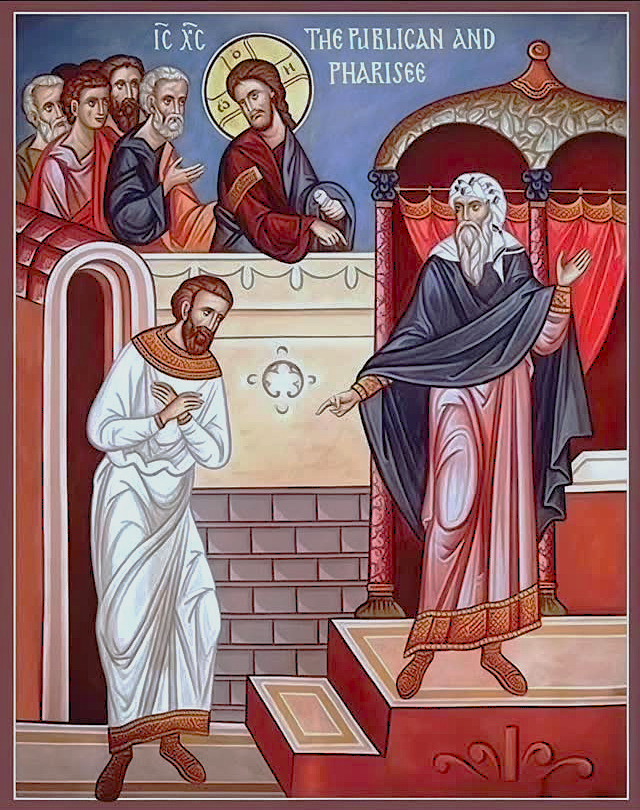
and the Tax Collector Icon,
Byzantine, Modern
Translation of the Epistle for the Tenth Sunday After Pentecost (1 Cor 12:2-11)
Brethren, You know that, when you were heathens, you went to dumb idols, according as you were led, Wherefore I give you to understand, that no man, speaking by the Spirit of God, saith Anathema to Jesus and no man can say, The Lord Jesus, but by the Holy Ghost. Now there are diversities of graces, but the same Spirit; and there are diversities of ministries, but the same Lord; and there are diversities of operations, but the same God, who workth all in all. And the manifestation of the Spirit is given to every man unto profit. To one indeed, by the Spirit, is given the word of wisdom; and to another, the word of knowledge, according to the same Spirit; to another faith in the same Spirit; to another, the grace of healing in one Spirit; to another, the working of miracles; to another, prophecy; to another, the discerning of spirits; to another, divers kinds of tongues; to another, interpretation of speeches. But all these things one and the same Spirit works, dividing to every one according as He will.
Continuation of the Holy Gospel According to Saint Luke (Luke 18:9-14)
At that time, Jesus spoke this parable to some who trusted in themselves as just and despised others. Two men went up into the temple to pray: the one was a Pharisee, and the other a Publican. The Pharisee standing, prayed thus with himself: O God, I give Thee thanks that I am not as the rest of men, extortioners, unjust, adulterers; as also is this Publican. I fast twice in the week; I give tithes of all that I possess. And the Publican standing afar off would not so much as lift up his eyes towards heaven, but struck his breast saying: O God, be merciful to me a sinner. I say to you, this man went down to his house justified rather than the other: because every one that exalts himself shall be humbled, and he that humbles himself shall be exalted.
The Saving Words of the Gospel.
In the Name of the Father, and the Son, and the Holy Ghost. Amen.
Transcription of Homily
~Fr. Ermatinger
In the early forties, a certain Jesuit missionary was assigned to Hiroshima, and he tells the story of this girl, Catholic convert Nakamura-san, who was insulted in front of the other college students, and, you know, in an honor society that means a lot. And so, she was afforded the opportunity the next day to defend her name from the insult and confront her accuser in front of the entire school assembly. And she showed up, and everybody was waiting with a bit of anticipation, and she said, “Well, this was said about me (whatever the accusation was), and I thank you for bringing that to my attention. If anybody else here knows of any defects in my character, please let me know so I can work on it.”
Well, that same missionary, after the U.S. dropped the bomb on Hiroshima, was doing his rounds the day after visiting the wounded, and there he found this young girl who was just one gaping, oozing wound. And she was on her way out, and, as she saw the priest, all she said was, “Did you bring communion?” That was her only thought. To receive Eucharist before she died.
I mention this because here we have this parable told by Our Lord in which we see two very different souls and what divides them, one from another, what makes one endearing to Our Lord, and what makes the other repellent. Above all, it’s humility, and humility is the foundational virtue of the entire spiritual edifice that allows all of the other virtues to flourish, and without humility those other virtues become a kind of some sort of cheap imitation. They’re not real. When Our Lord points to Himself as a model for us to follow, He doesn’t point out His brilliance, or His strength, His ability to fast for forty days; He points to His Humility: “Learn from me for I am meek and humble of heart.” And this is really what makes the soul so pleasing to our Lord because then Our Lord has something to do with that person. He has permission to work on that person.
We have this kind of a caricature of a person, this Pharisee. Pharisees mean separated ones. Because of their cleansing rituals, they considered themselves separated from everybody else. And it says, “He stood and prayed,” and it says in St. Jerome’s Vulgate apud se, which means he prayed to himself or he prayed within himself. In other words, this was not a true prayer. It wasn’t really directing his heart, his mind to God. He was talking to himself, about himself, and this really became something of a kind of like a shellacked heart that’s impenetrable by grace. And as he’s speaking, singing his own praises to himself, about himself, he points to the Publican and mentions – for somebody’s benefit, I suppose – he mentions his sins.
When St John Chrysostom comments on this Gospel passage, he says something that’s actually rather fascinating. Rather than juxtapose the two as polar opposites, he says, “Notice how the publican doesn’t deny the accusations of the sins said about him; rather he allows the accusation of those sins to increase his humility.”
St. Augustine says that these two are standing, but they have different interior postures. One is looking inward and upwards. And the other doesn’t even dare look up because of his shame and his sorrow for his sins, and that this is what wins the heart of the Father.
St. Cyril, commenting on this, says that yes indeed the Pharisee fasts, and what would otherwise be a fragrant offering of perfume to Our Lord is mixed with dung because of his pride. And so, pride will then invitiate every attempt at prayer, or fasting, or virtues; just makes it kind of counterfeit and repellent to Our Lord.
When St. John Chrysostom mentions this, the accusation of the Pharisee against the Publican, it reminded me of that scene in 2 Samuel 16 in which David is walking with his soldiers, and Shimei is on this other ridge, and he starts cursing and insulting David, and David’s soldiers are incensed. They said, “Can we go and run through with our spears?” and David’s humble response really impressed me. He says, “No.” He said, “What he’s saying is for my own spiritual benefit. If God has allowed it, then it’s for some good.” So, he doesn’t defend himself; he allows that disagreeable situation to be to his own spiritual benefit.
So, the Publican is beating his breast in contrition, which is actually where we get the tradition in Mass during the Confiteor of striking our own breast. And St. Augustine says that this rubric that we follow ever since this Gospel in every Mass. He says, “You wish to bring to light what is hidden in one’s heart and by this beating of the breast cleanse what is hidden.” And St. Jerome says, “Because the heart is the seed of every unworthy thought, we beat it a symbolic way in our Confiteor to dispel those thoughts and purify what is hidden there.”
And so, the correction of others, sometimes as difficult and humbling as it may be when it’s true, is actually a blessing. If they’re false, St. Thomas à Kempis says in his Imitation of Christ that if the accusations are false, he says, we’re faced with a choice. We can either remain silent and accept it with humility, or, he says, if it’s going to scandalize somebody who hears that and believes it and, therefore, receive a bad example, we can defend ourselves, but we have to give it thought, right? Who am I serving here? We all have hidden faults that we would rather not face up to, and sometimes it’s indeed the comment of another that reveals something to us that perhaps we knew was there but didn’t want to face up to, or we’re completely unaware of.
Other times things occur to us; maybe if we’re in Adoration, if we’re in mental prayer or spending time with Our Lord, we can remember things that we didn’t confess. And that’s the Holy Spirit working. He often works through his agent, our Guardian Angel. And that brings me to another point, which is to know what is hidden in our hearts, what we still need to confess. It’s very helpful and salutary to ask your Guardian Angel, ‘What is there in me that God wants me to change? What is there in me that I haven’t faced up to? What is there in me that would turn God away from me so I can be truly converted?’ We have to be careful not to become neurotic and believe every thought that occurs to us, for sure.
And one way to discern whether something is actually from God or something is from the enemy is how it is packaged when it comes to my mind. When something is from the Holy Spirit, it comes with gentleness and peace because He is eminently constructive. He shows us what it is He wants us to work on so that we can be converted and pleasing to God. And it comes with peace, and it’s always ordered towards reconciliation. When it comes from the enemy, it’s heavy, it’s weighty, it’s onerous, it’s dark; we don’t see a way out. It doesn’t lead us to trust in mercy. And so, this is a principle of discernment of spirits to know what’s the source of this accusation.
Certainly, another means to know what’s in our hearts and what we need to work on is our nightly examination of conscience. Not to go to bed until we’ve done a brief, and it should be brief, examination of conscience. It’s good to start first of all thanking God for the graces of the day, thanking him for those moments when we cooperate with his grace, and then recognize where we received God’s grace and didn’t cooperate with it. To take note of it. This is going to be a great help for preparation for Confession. And as we confess our sins, we not only receive forgiveness; we also receive the grace to overcome the things that we accuse ourselves of.
And so, this is part of the path to humility. Humility like that of Nakamura-san. Humility like King David. Humility like this Publican who can turn these thoughts, these accusations, to God’s glory and one’s own debasement in order to allow God to live and act within us.
In the Name of the Father, and the Son, the Holy Ghost. Amen.